Rose’s first consultation at Gómez’s clinic
Hot MilkRose Papastergiadis’s first consultation at the Gómez Clinic brings a long, uncertain search for an explanation of her illness into a new clinical setting. The visit is a turning point not because it produces a settled diagnosis, but because it makes the practical and emotional stakes visible: Rose Papastergiadis’s treatment has required the remortgaging of her home, Sofia Papastergiadis has made a vocation of reading her mother’s symptoms, and Dr Gómez begins to question how care and medication have organized both their lives.
Journey to the clinic
The journey to the clinic near Carboneras follows years in which doctors in the United Kingdom had been unable to explain Rose Papastergiadis’s changing symptoms. The family has remortgaged her house to pay for treatment: the total cost is twenty-five thousand euros. For Sofia Papastergiadis, this is not an isolated medical decision but the latest stage in an investigation she has been conducting for about twenty years, nearly as long as she can remember. As a child of four, she asked what a headache meant and was told it felt like a door slamming inside Rose Papastergiadis’s head. Since then, Sofia Papastergiadis has learned to read the symptoms as if her mother’s head were her own, and she casts herself as an unwilling detective trying to discover the cause of an illness that repeatedly produces new pains and new prescriptions. Even antidepressants prescribed in Britain for the nerve endings in Rose Papastergiadis’s feet become part of a puzzle that has not yielded a dependable answer.
The journey also takes place amid immediate discomfort and uncertainty. The taxi’s air conditioning makes the desert heat feel like a Russian winter, and Sofia Papastergiadis asks for it to be turned down. Her shoulder is still sore from a jellyfish sting sustained the previous day. Rose Papastergiadis rests her head on that shoulder, and Sofia Papastergiadis resists shifting away because she knows her mother is frightened and feels obliged to conceal her own fear. The care on display is physical and ordinary—offering a shoulder, enduring pain, keeping pace—before either woman enters the clinic.
The setting intensifies the sense of a last resort. The taxi passes through palm-fringed grounds advertised as a small ecological oasis, where two pigeons shelter beneath mimosa trees, before reaching the cream-coloured marble dome built into the scorched mountainside. Its curved form and glass entrance had seemed less reassuring in online images than they do in person. The walk from the taxi to the doors takes fourteen minutes. When the receptionist calls for Rose Papastergiadis, Sofia Papastergiadis takes her arm and they limp together across the marble floor. Sofia Papastergiadis describes this shared pace as a way of moving forward: her legs become her mother’s legs. The contrast is sharp because Rose Papastergiadis had walked alone to a local Spar that morning to buy hairpins, without even taking a walking stick. The clinic’s nurse then takes over, pushing Rose Papastergiadis in a wheelchair while Sofia Papastergiadis follows. The relief of handing care to someone else sits beside the sight of another, easier kind of walking, unburdened by pain or family obligation.
Examination and the search for a pattern
The consultation carries the weight of a final journey. For years, an increasing number of medical professionals in the United Kingdom had struggled to diagnose Rose Papastergiadis; the trip to southern Spain therefore feels to Sofia Papastergiadis like a pilgrimage and a last chance. Dr Gómez, an orthopaedic consultant whom Sofia Papastergiadis has researched for months, receives them in a pinstriped suit, with silver hair marked by a striking white streak. The clinical encounter begins in a room reached through the clinic’s curved corridors, but its terms are not yet clear: the family has brought a history of symptoms, not a single complaint that can be easily isolated.
During the examination, Dr Gómez kneels at Rose Papastergiadis’s feet and looks into her eyes as she sneezes. Rose Papastergiadis asks Sofia Papastergiadis to fetch another tissue, then explains that sneezing brings a sharp, tearing pain in her left arm, which she must hold until the sneeze passes. A moment later, Dr Gómez asks Sofia Papastergiadis not to pick up her mother’s shoes. He is examining the sole of Rose Papastergiadis’s right foot and finds two ulcers, one of them slightly infected. He asks whether she has been tested for diabetes; she has. The small, visible injury demands immediate attention, but it does not resolve the broader mystery of her pain and mobility. The consultation thus places a concrete finding alongside the much larger uncertainty that brought the family to the clinic.
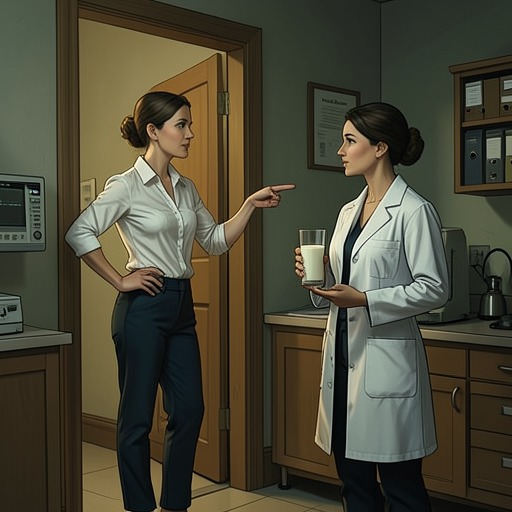
Dr Gómez also turns to the records. He calls Sofia Papastergiadis by her full passport name and shows her a black-and-white, high-definition X-ray of Rose Papastergiadis’s spine, identifying it as a back view. Sofia Papastergiadis explains that she had asked doctors in Britain to send the images, but they are now out of date. Dr Gómez proposes taking new images and comparing them in search of abnormalities. His attention moves between the examination, the available evidence, and everyday interruptions: he briefly listens to a Spanish radio broadcast about the austerity programme before assuring Rose Papastergiadis that he is a doctor and saying he wants to review her medication with her that afternoon. He asks which medicines she is most attached to and which she could let go, and brings her water when she asks for it. The consultation is therefore not limited to imaging or bodily examination; it also opens a conversation about how treatment itself has become part of Rose Papastergiadis’s daily life.
Caregiving, illness, and competing accounts
The visit exposes a difference between the work of describing illness and the work of diagnosing it. Sofia Papastergiadis has long tried to identify the triggers and meanings of Rose Papastergiadis’s aches, but each apparent breakthrough gives way to another unexplained symptom and another prescription. She understands this sustained attention as training for anthropology: symptoms have histories, contexts, and interpretations, even when they do not add up to a diagnosis. The consultation gives Dr Gómez access to clinical records and examination, while Sofia Papastergiadis carries an intimate, accumulated knowledge of Rose Papastergiadis’s complaints. Neither form of knowledge automatically cancels the other.
Later, when Rose Papastergiadis gives a history of her present illness to Julieta Gómez, the account moves among present symptoms, childhood illness, and the past rather than following a straightforward chronology. Julieta Gómez will have to transcribe and shape those words into a case history. Sofia Papastergiadis recognizes the problem because ethnographic work also involves describing testimony, but she is not fully listening in that moment. She is physically present while mentally elsewhere. The scene clarifies why the first consultation cannot simply be reduced to a list of symptoms: the patient’s history arrives as a layered, shifting account, and the relative listening to it is both trained to interpret and exhausted by years of attention.
The financial and bodily pressures of care remain linked. The twenty-five-thousand-euro treatment has been made possible by remortgaging Rose Papastergiadis’s home, while Sofia Papastergiadis returns to work making espresso and her mother returns home to list further aches and pains. Sofia Papastergiadis admits that the symptoms interest her as an anthropologist even as they drag her down. She also notices that she sometimes finds herself limping after the journey, as though her body has remembered the pace she adopts when walking with her mother. The consultation’s caregiving pattern thus extends beyond the clinic: Rose Papastergiadis’s impairment shapes Sofia Papastergiadis’s movements even when they are apart.
Aftermath and significance
The first consultation begins a treatment process without closing the diagnostic question. In a later conversation, Rose Papastergiadis reports that Dr Gómez knows little about chronic pain and that her pain continues to magnify; her feet, she says, are numb rather than painful. This admission complicates the authority attached to an expensive specialist visit. The clinic can examine, compare images, attend to ulcers, and reconsider medication, but the patient’s account still includes symptoms that have not yielded their secrets.
Dr Gómez’s later intervention makes the caregiving relationship itself part of the treatment problem. He tells Sofia Papastergiadis that administering her mother’s medication has become a ritual and suggests that she has used Rose Papastergiadis as a shield against making a life of her own. He has erased the medication routine from both women’s lives and insists that Sofia Papastergiadis will have to invent another one. This is a consequential interpretation, not a diagnosis of Rose Papastergiadis’s condition: it redirects attention from the mother’s body alone to the structure of care that has occupied the daughter’s time and purpose.
The course of treatment also brings the limits of medication and basic care into view. At a later review, Dr Gómez explains that Rose Papastergiadis had been dehydrated and treated with intravenous saline, and that difficulty swallowing water also makes it difficult for her to swallow medication. The fact gives the earlier request for a glass of water a wider significance: hydration is not incidental to treatment when swallowing itself has become a problem. Yet the narrative does not present one straight line from consultation to recovery. At a later point, Rose Papastergiadis, then sixty-four, walks barefoot along the shore in a sunflower-patterned dress, carrying her hat in one hand. Sofia Papastergiadis sees her walking independently and, unable to approach, returns to the sea; the sight of Rose Papastergiadis’s feet still attached to her body unsettles the daughter’s habitual image of herself as her mother’s legs. That later walk does not prove that the clinic cured her. Instead, it sharpens the event’s central uncertainty: mobility can appear, disappear, and return, while the work of interpreting illness and caring for the person who lives with it continues.